Last updated October 30, 2026
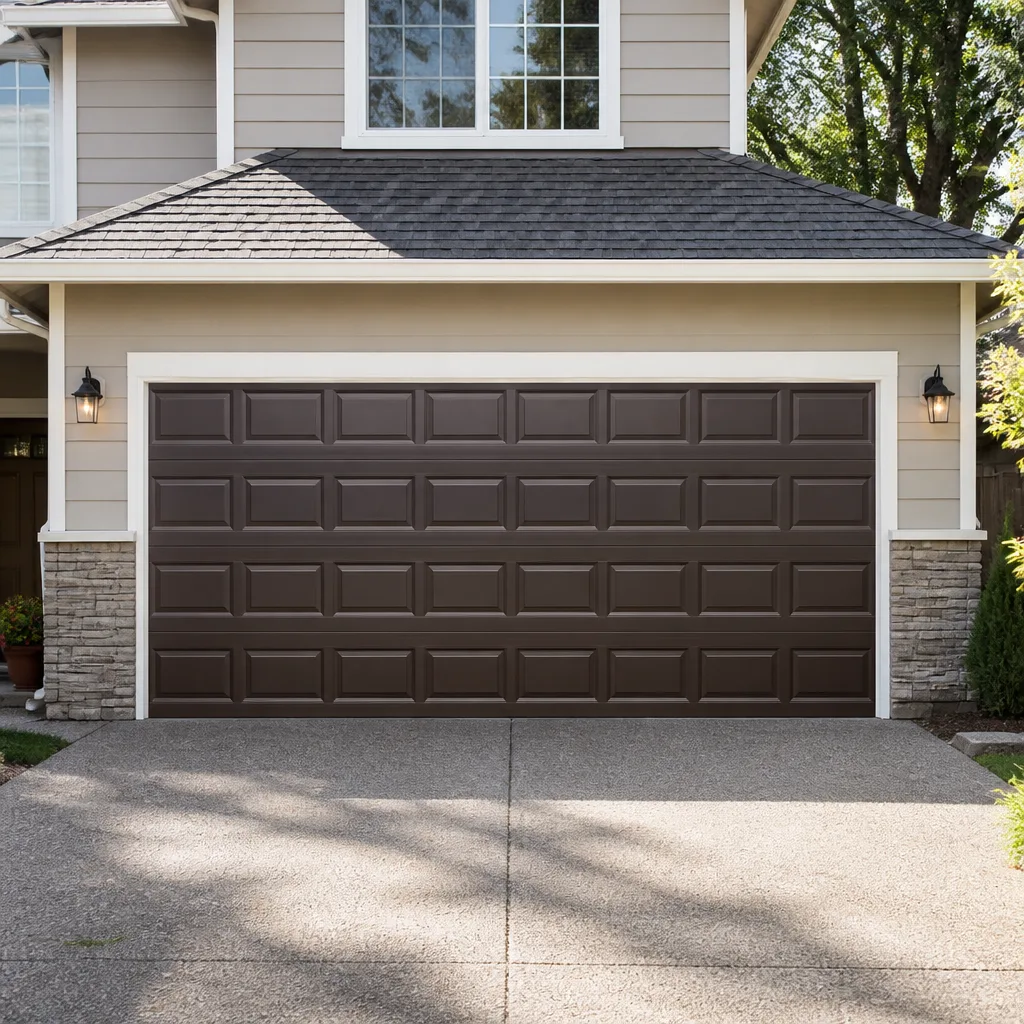 Raised-panel steel
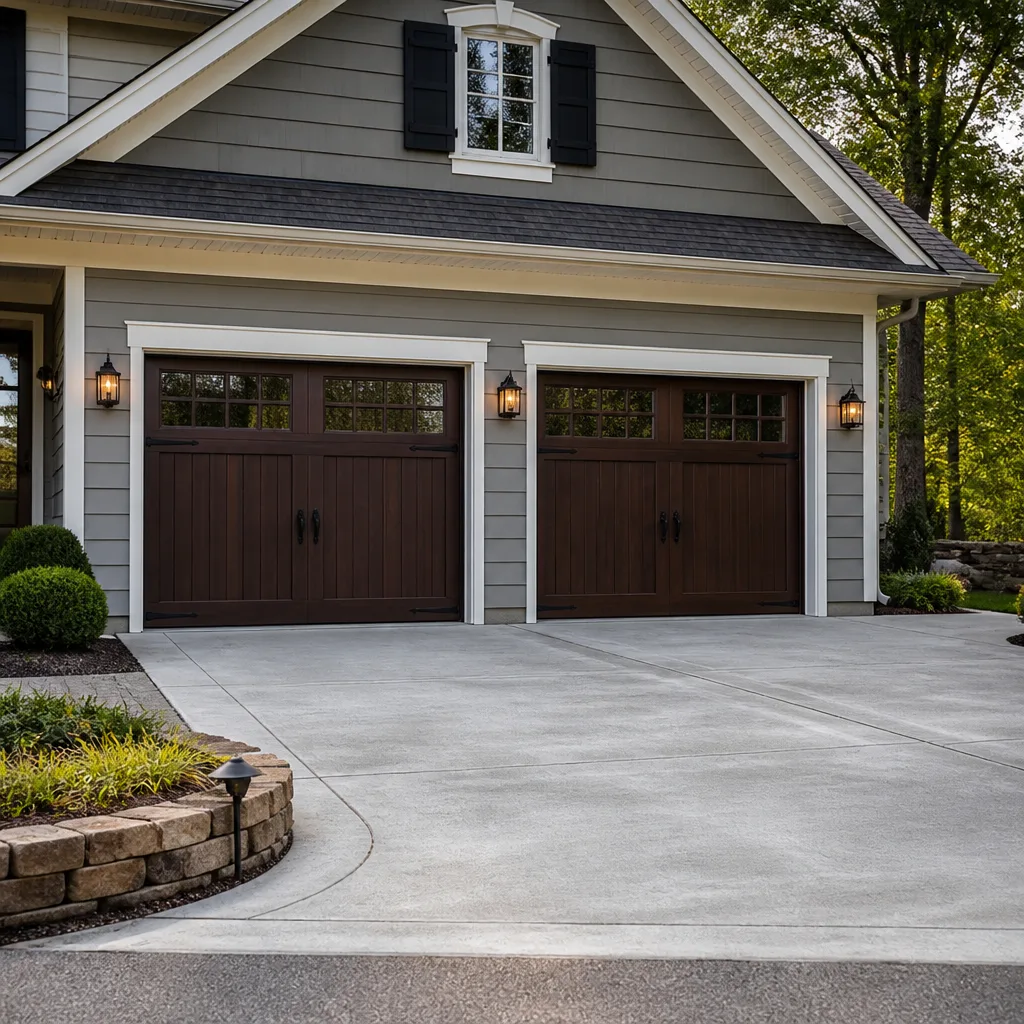 Carriage house
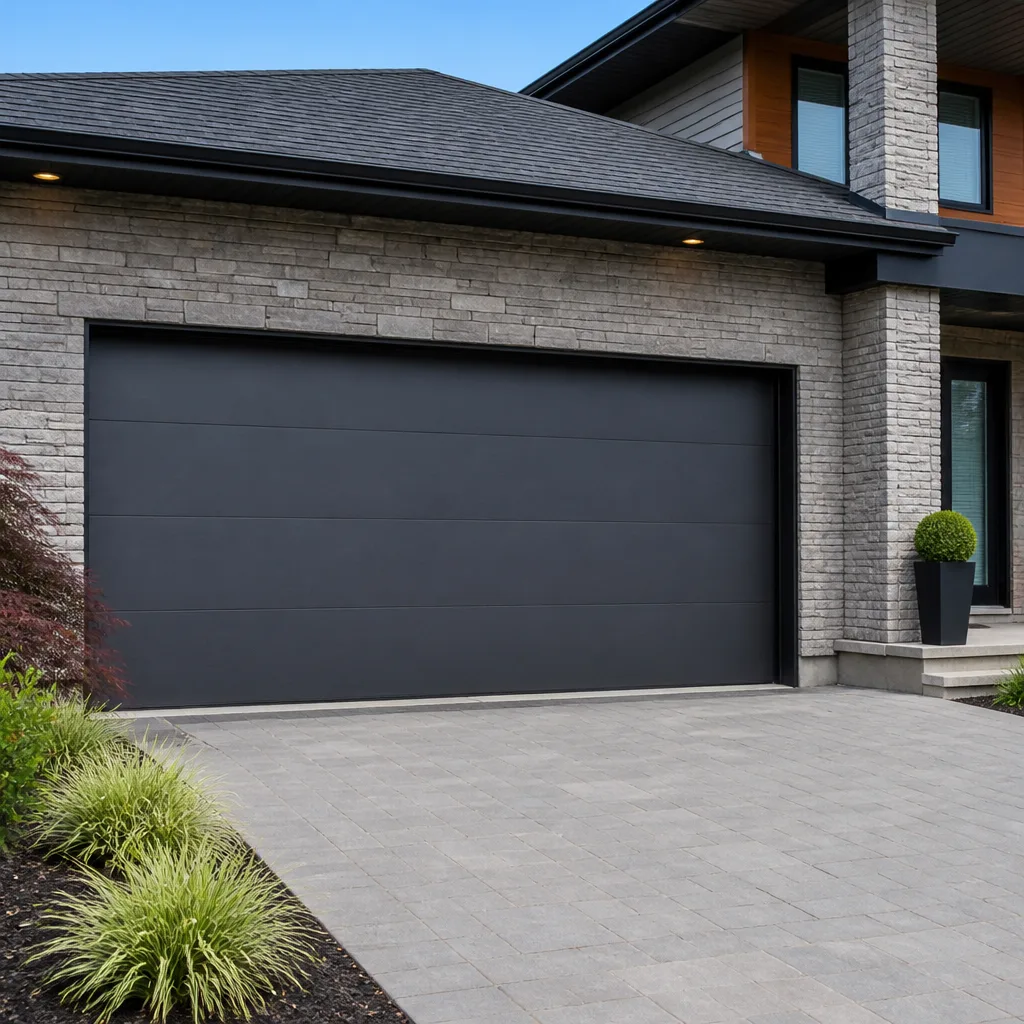 Modern flush
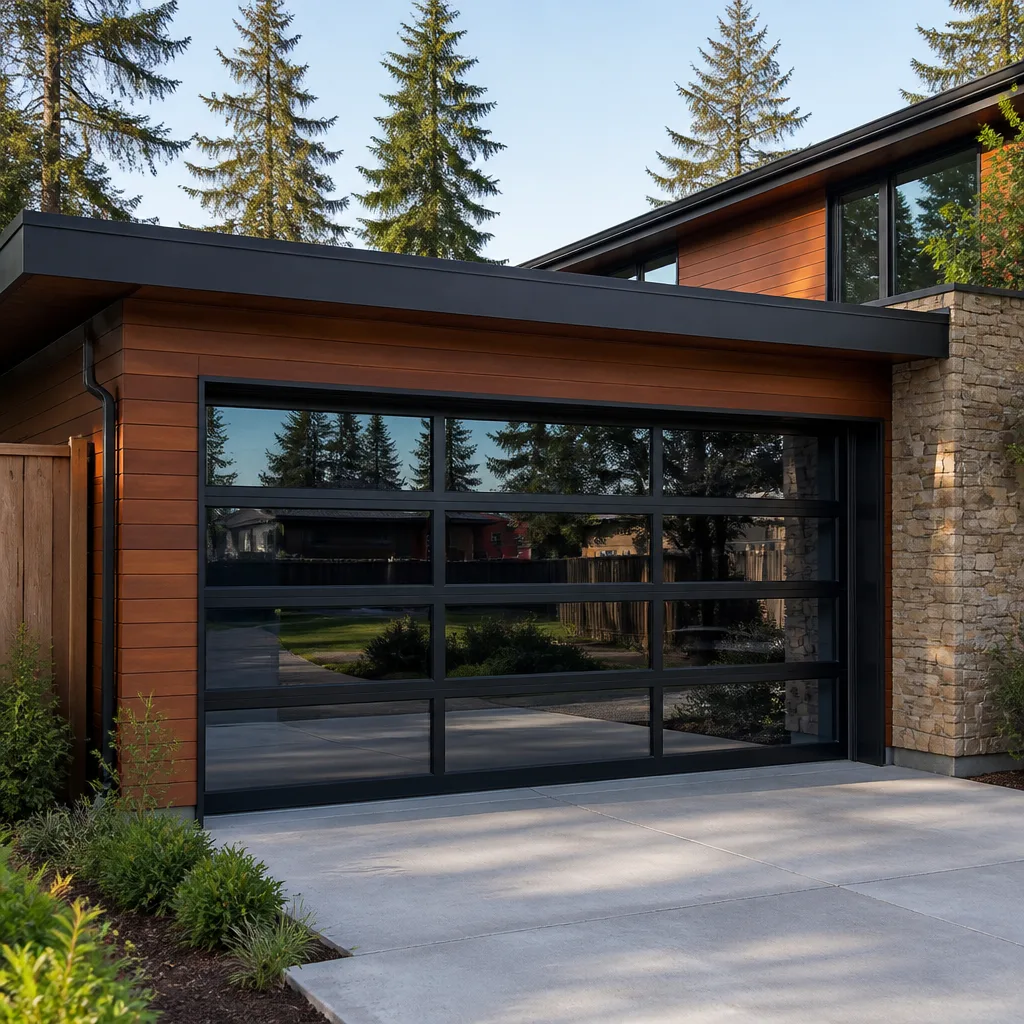 Full-view glass
 LiftMaster openers
 Chamberlain openers
Full 25-point door and opener safety check with every visit - springs, cables, rollers, tracks, and your LiftMaster or Chamberlain opener included
You get a price before we start. It does not change when the truck arrives.
Get your free estimateGarage Door Warning Signs: A Fort Lauderdale Homeowner’s Reference Guide
Here’s a pattern we see every week in Fort Lauderdale: a homeowner notices their garage door closes slightly slower on Tuesday, hears a faint pop on Thursday, and by Sunday morning the door won’t open at all, the spring has snapped, and the repair bill is triple what it would have been four days earlier. Garage doors rarely fail without warning. The problem is that most homeowners don’t know which warnings matter and which ones can wait. This guide maps the specific symptoms you’ll see on a garage door in South Florida, translates each one into plain-language diagnosis, and tells you exactly when to stop using the door and pick up the phone. For a deeper look at proactive upkeep, see our Seasonal Garage Door Care for Fort Lauderdale: Year-Round Homeowner’s Guide. By the end, you’ll know more about your garage door’s warning language than most handymen do.
Styles & brands we work with
Quick Answer
The most common garage door warning signs in Fort Lauderdale include grinding or squealing during operation, slow or uneven movement, visible rust on springs and cables, a door that reverses before closing, and a bottom seal that’s cracked or pulling away from the floor. Any single symptom is worth investigating, but a combination of two or more usually means a component is actively failing. If you hear a loud pop from the spring area or see a visible cable fray, stop using the door immediately and call a garage door specialist before operating it again.
Table of Contents
- The Sound Diagnostic: What Your Garage Door Is Telling You
- Rust and Corrosion: South Florida’s Constant Battle
- Slow or Uneven Movement: Three Causes, Three Different Fixes
- Fort Lauderdale-Specific Warning Signs: Salt, Humidity, and Heat
- The Emergency Stop List: Five Symptoms That Mean Do Not Operate
- Opener Warning Signs: When the Motor Is the Problem, Not the Door
- Age Milestones: What to Expect From a 5, 10, and 15-Year-Old Door
- Common Mistakes to Avoid
- When to Call a Professional
- Frequently Asked Questions
- The Bottom Line
The Sound Diagnostic: What Your Garage Door Is Telling You
A garage door is one of the few mechanical systems in your home that talks to you constantly. Every cycle, every movement, produces sound. Most sounds are normal: the low hum of the motor, the soft roll of hinges, a faint click when the door settles into the closed position. But four specific sounds in Fort Lauderdale garages indicate real problems, and each one points to a different component. Here’s how to read them.
Grinding: The Opener’s Drive Gear Is Wearing Down
A grinding sound that seems to come from the opener unit itself, not the door, usually means the drive gear inside the opener is stripping. This is extremely common on older LiftMaster and Craftsman chain-drive openers. The gear is made of plastic or nylon, and it’s designed to be the sacrificial part so the motor doesn’t burn out. In Fort Lauderdale’s heat, these gears degrade faster than they do in cooler climates because the plastic softens under sustained high temperatures in unconditioned garages. If you hear grinding on a door that’s more than seven years old, the gear is likely on borrowed time. We work on your brand, so whether it’s a Wayne Dalton opener or a newer Chamberlain, the gear issue can usually be repaired in a single visit if caught before the motor overheats. Not sure which brand suits your home? Our Choosing the Right Garage Door Brand: A Buyer’s Guide for Fort Lauderdale breaks down the options.
Squealing: Hinges, Rollers, or a Dry Bearing
Squealing is the most common sound complaint, and it’s also the least expensive to fix if caught early. In most cases, the squeal comes from metal-on-metal contact at the hinge points or roller stems. Over time, the factory lubrication wears away, and Fort Lauderdale’s humidity accelerates the process by promoting surface rust on the hinge pins. A penetrating lubricant applied to each hinge and roller stem often solves it. But there’s a second possibility: the torsion tube bearings at the top of the door can dry out and squeal. That’s not a DIY job, because the torsion tube is under spring tension. Here’s the distinction: a squeal that’s clearly coming from the side hinges is worth lubricating yourself; a squeal that seems to come from above the door, near the spring bar, is a sign that the bearing may be failing.
Popping: Torsion Spring Fraying
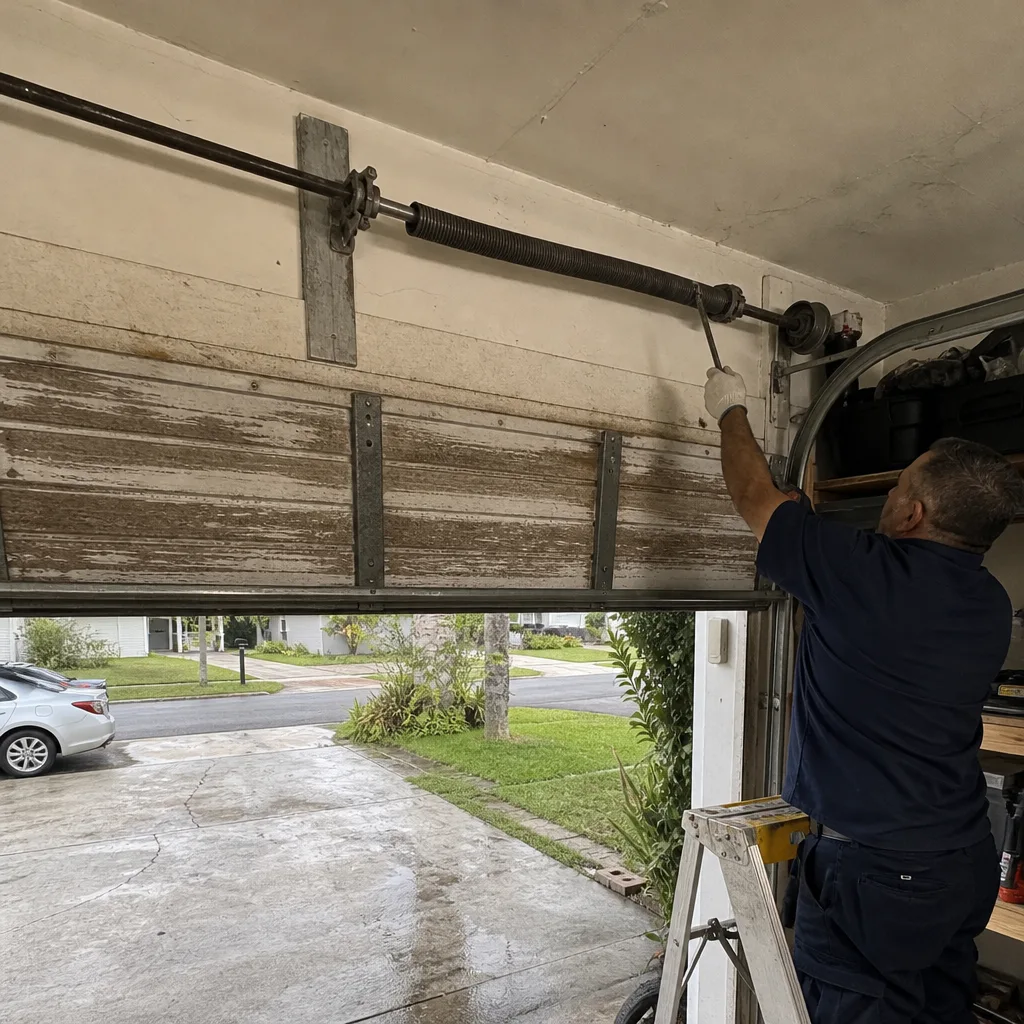
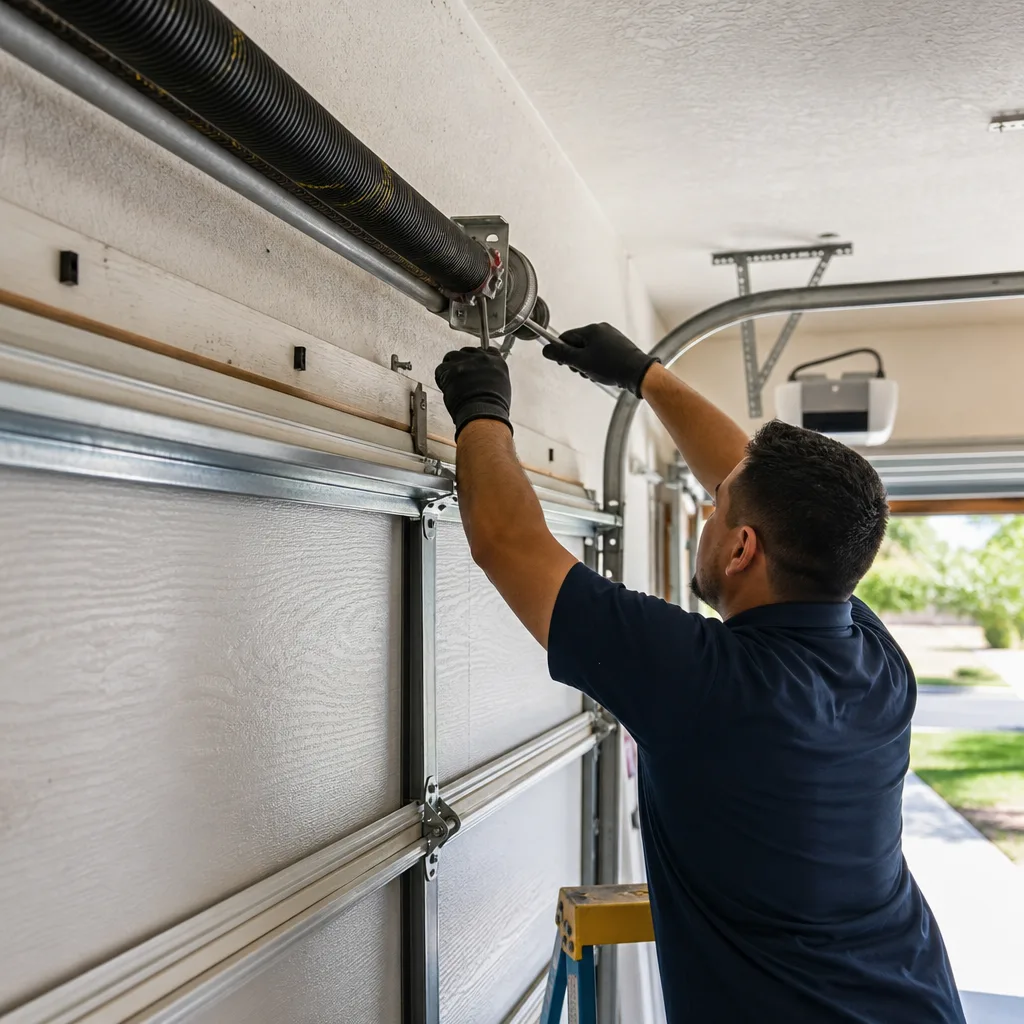
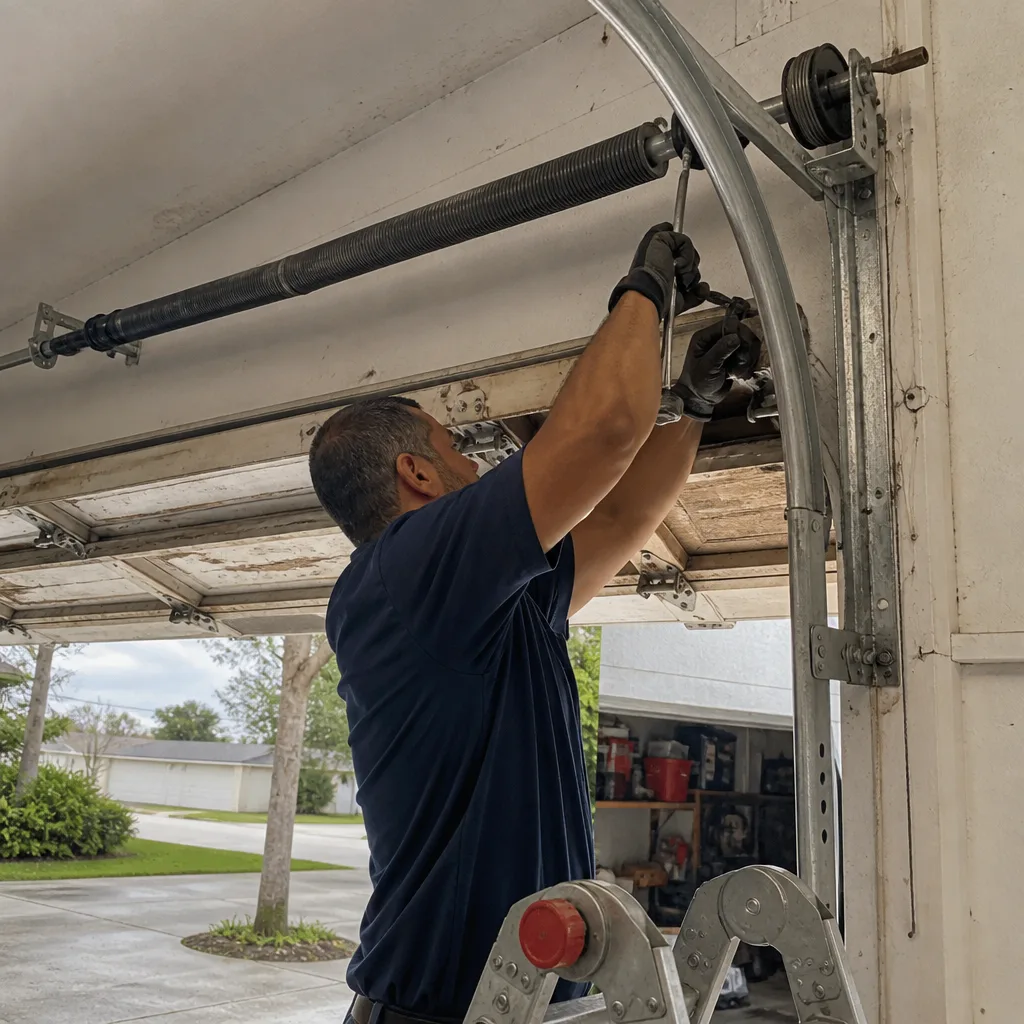
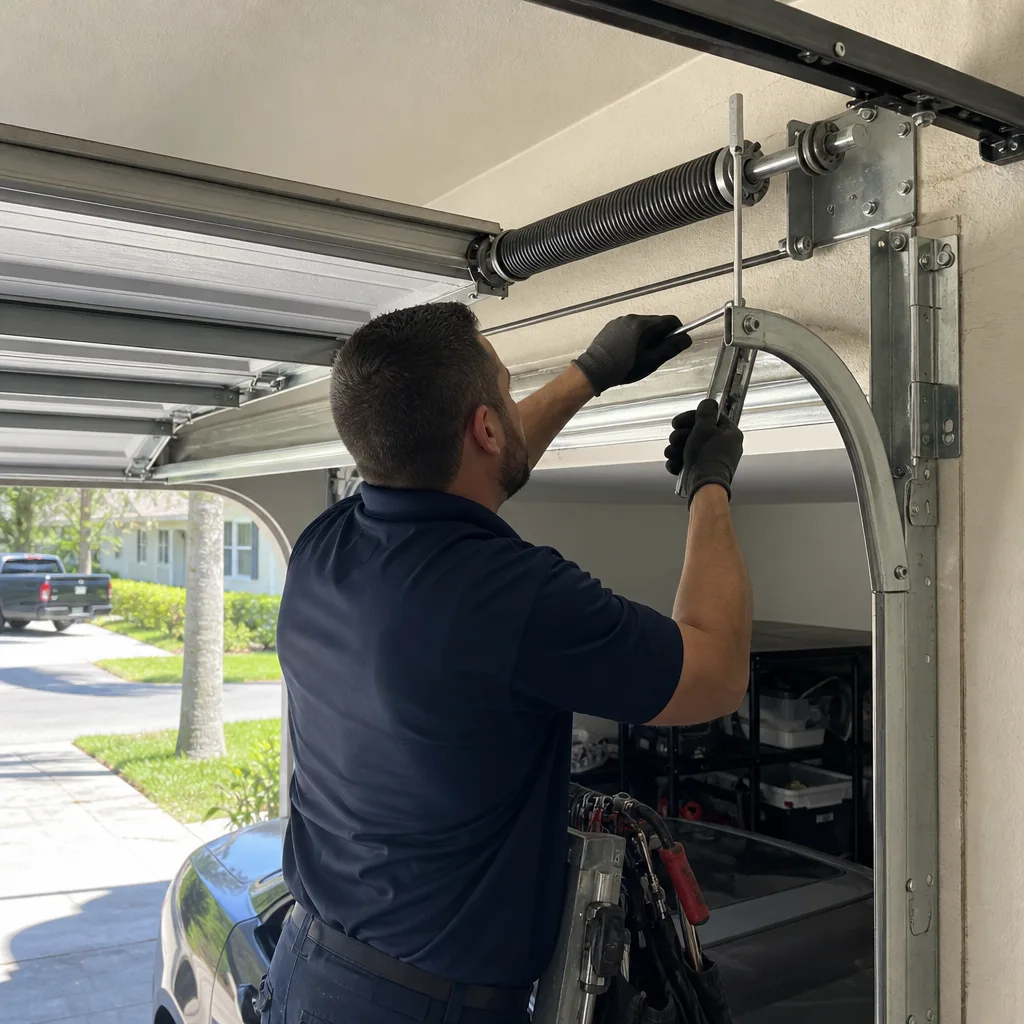
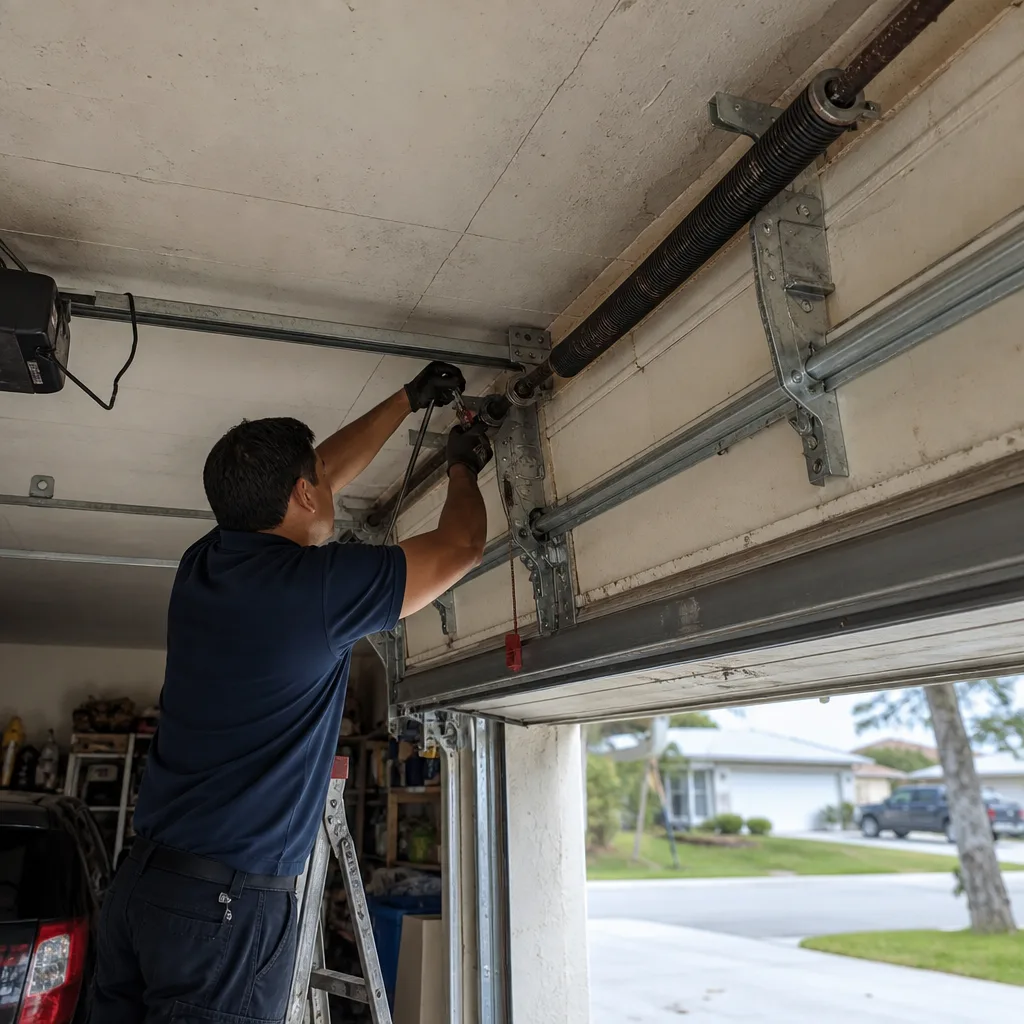
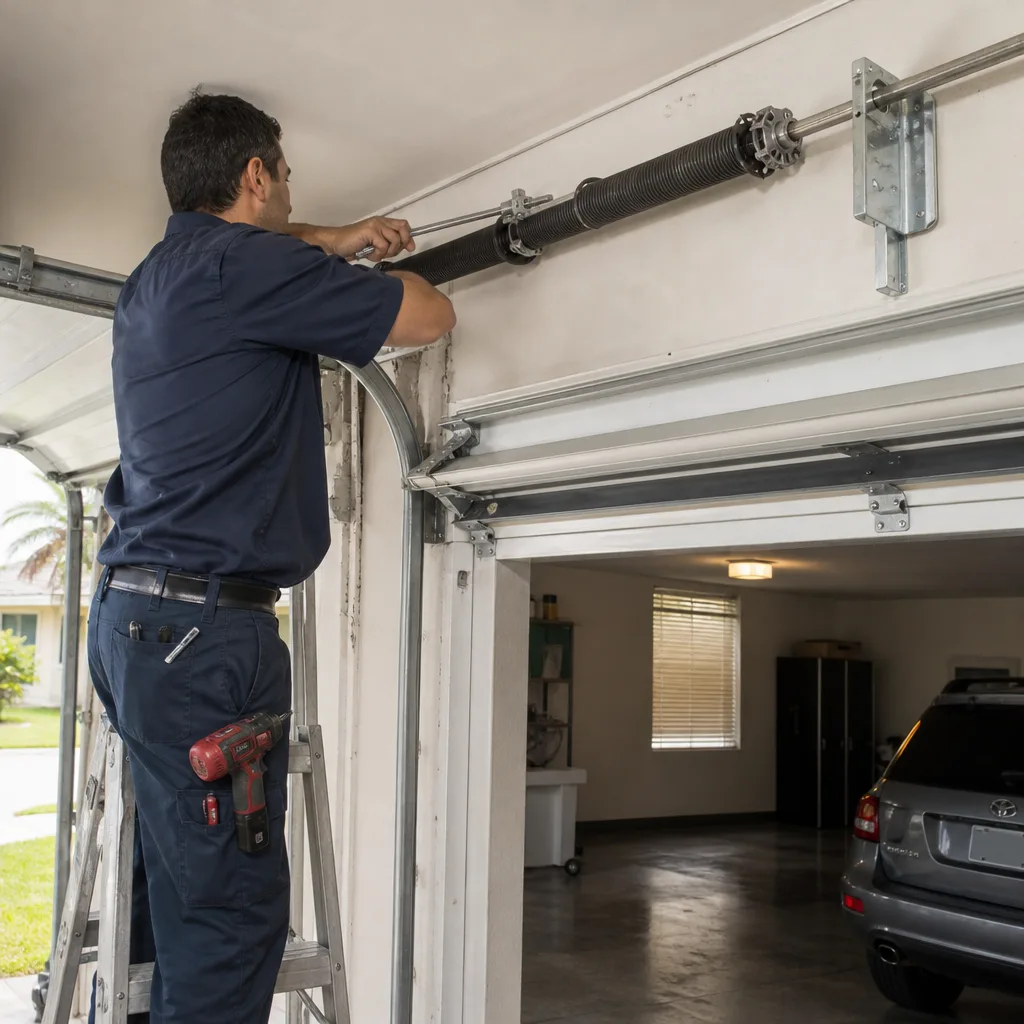
A single loud pop from the spring area is the sound of a torsion spring breaking. But here’s what most homeowners miss: before the final break, many springs emit a series of smaller pops or creaks as individual coils begin to separate. This is the warning period. In Fort Lauderdale, the salt air contributes to micro-corrosion on spring surfaces, which creates weak points at the coil boundaries. If you’ve heard one or two pops from above the door and the door still operates, the spring has likely started to fracture internally. A spring that’s actively fraying can snap without warning under full tension. This is a same-day call. For reference, garage door repair in Fort Lauderdale typically runs significantly less when the spring is caught during the fraying phase than after a full snap, which can also damage cables, drums, and the opener itself.
Rattling: Loose Hardware or a Failing Roller
Rattling during door travel usually means something is loose. On older Amarr and Clopay doors, the culprit is often the bolts that secure the vertical track to the wall brackets. They back out gradually from thousands of open-close cycles. A second common source is a roller whose stem has worn down inside the hinge barrel, letting the wheel wobble against the track. Rattling is worth addressing early because loose hardware creates misalignment, and misalignment creates uneven wear on the cables. In our experience serving Fort Lauderdale homeowners, about half of all rattling complaints resolve with track bolt tightening and roller inspection, both quick fixes when caught before the door’s geometry drifts.
Rust and Corrosion: South Florida’s Constant Battle
Every metal component on a garage door is in a slow fight with Florida’s atmosphere. The salt air from the Atlantic, combined with humidity that regularly exceeds 70 percent in Fort Lauderdale, creates a corrosion environment that homeowners in inland communities simply don’t face. But not all rust is equal. There are two categories, and treating them the same way is a costly mistake.
Surface Oxidation: Treatable, Cosmetic, Not Urgent
Surface rust appears as a reddish-brown film or light flaking on exposed metal. On most garage doors in Fort Lauderdale, you’ll see it first on the bottom panel, especially near the corners, and on the lower portion of the vertical tracks. This kind of rust is cosmetic. It can be removed with a wire brush and sealed with a rust-inhibiting primer or a cold-galvanizing spray. The key question is whether the rust has penetrated. If you can scrape it away and find solid metal underneath, the door’s structural integrity is intact. Many Clopay and Amarr steel doors are built on galvanized or primed steel frames specifically to resist Fort Lauderdale’s salt environment, and surface rust on those doors is usually from scratches in the factory finish, not a fundamental failure.
Structural Corrosion: Dangerous, Requires Component Replacement
Structural corrosion is different. This is rust that has eaten into the metal, causing pitting, thinning, or flaking that extends below the surface. On garage door springs, structural corrosion appears as dark pitting or orange scaling between the coils. On cables, you’ll see individual wire strands separating or a dull, rough texture replacing the smooth steel finish. On hinges and brackets, structural corrosion shows as thinning metal around the bolt holes. Here’s the bottom line: a spring or cable with structural corrosion is a failure waiting to happen. The spring is under constant tension, and corroded coils lose tensile strength unpredictably. A cable with visible strand separation can snap at any point in the lift cycle, and when it does, the door drops suddenly. If you’re seeing this level of corrosion on a Fort Lauderdale garage door, do not attempt to lubricate, adjust, or “clean up” the affected components. The spring and cable system needs professional assessment, and in most cases, replacement.
A good rule of thumb we share with Fort Lauderdale homeowners: if the rust wipes off on your finger as a powder, it’s surface-level. If it flakes off in rigid chunks or the metal underneath looks pitted like a golf ball, the component has lost structural integrity. That’s the dividing line between a cosmetic issue and a safety issue.
Slow or Uneven Movement: Three Causes, Three Different Fixes
“My door’s been closing slower lately.” We hear this phrase constantly, and it’s usually followed by the owner assuming the opener motor is dying. In Fort Lauderdale garages, the opener is often the last thing that’s actually failing. Slow or uneven movement has three dominant causes, and each one points to a completely different repair strategy. Here’s how to separate them.
- Spring tension loss: Torsion springs are rated for a specific number of cycles, typically 10,000 to 20,000 depending on the spring quality. As the spring wears, it loses tension gradually. The door becomes heavier for the opener to lift, which causes noticeably slower operation, especially in the first half of the lift cycle. If your door is seven or more years old, gets daily use, and has started moving noticeably slower, the spring is likely nearing the end of its functional life. This is not a fire drill, but it is a warning. Schedule a spring assessment before the final snap.
- Binding cable or misaligned track: If your door moves slower on one side or hesitates partway up, the cause is usually mechanical binding. A cable that’s come off its drum, a track that’s been knocked out of alignment, or a roller that’s seized inside its hinge can all create drag that the opener fights against. The critical detail: if the opener is fighting binding, the motor is working harder than it was designed to, which shortens its life. This is where the full-system approach matters. A company that fixes the door but ignores the opener will leave you with a burned-out motor in six months. One call covers the door and the opener.
- Opener motor decline: On doors older than 10 years, especially those with original opener motors, genuine motor decline is possible. Symptoms include slow operation from the start of the cycle, a motor that’s hot to the touch after one cycle, and intermittent failure to complete the lift. But here’s the diagnostic rule: if the door is hard to lift manually when disengaged from the opener, the problem is the door’s spring or hardware, not the motor. If the door lifts easily by hand but the motor struggles, the problem is the opener. Many Fort Lauderdale homeowners pay for opener replacement when a spring is actually the issue, or vice versa, because the diagnosis was never separated between door and drive system.
For a deeper look at opener-specific failures, see garage door opener repair in Fort Lauderdale.
Fort Lauderdale-Specific Warning Signs: Salt, Humidity, and Heat
Garage door wear patterns change by geography. What kills a door in Phoenix is UV degradation. What kills a door in Minneapolis is cold-weather metal fatigue. In Fort Lauderdale, three environmental factors dominate: salt air, sustained humidity, and attic-level garage heat. Here are the warning signs specific to our climate that most generic guides miss.
Bottom Seal Deterioration: The Salt and Sun Combo
Your bottom seal is a rubber or vinyl strip that runs along the bottom edge of the door. In Fort Lauderdale, the seal gets hit from both directions: salt-laden moisture from below during the rainy season and intense UV from above all year. The typical failure pattern is cracking across the top surface combined with brittleness along the edge that contacts the concrete. When the seal fails, you’ll see daylight under the door, water pooling at the edges during heavy rain, and increased insect intrusion. Fort Lauderdale homeowners often notice the seal has failed only when summer rains start pushing water into the garage. A failed seal is a cheap fix if caught early, but the same water that gets past it also accelerates corrosion on the bottom panel and the track hardware.
Salt Pitting on Aluminum Panels
Aluminum garage doors, including many models from Amarr and Raynor, are popular in coastal South Florida because they resist rust. But they’re not immune. What you’ll see on aluminum doors in Fort Lauderdale is pitting: small, circular depressions in the metal surface, often appearing first on the lower panel and around the edges. This is galvanic corrosion triggered by salt deposits sitting on the metal surface. The pitting itself is cosmetic in early stages, but if left for years, the pits deepen into the metal and eventually perforate the panel. A regular wash with mild detergent and fresh water, followed by a wax or sealant, slows this dramatically. If your door sits within a mile of the Intracoastal or the ocean, this maintenance is not optional; it’s annual.
Humidity-Warped Wooden Sections
Wooden garage doors have a presence that steel and aluminum can’t match, and they’re still common on older Fort Lauderdale homes and in historic neighborhoods like Victoria Park and Sailboat Bend. But wood is a sponge for humidity. The warning signs include visible warping across the panel face, doors that no longer sit flush against the weatherstripping because the panel has bowed, and paint failure with moisture blisters underneath. A warped wooden door changes the door’s weight distribution, which throws off the spring tension over time. In severe cases, the door’s geometry changes enough that the rollers bind in the tracks. If you have a wooden door that’s showing warping, you have a decision to make: replace the affected sections, or plan for a full garage door installation in Fort Lauderdale. Patching warped wood is usually a losing game in this humidity.
Heat Stress on Opener Logic Boards
Fort Lauderdale garages routinely top 100 degrees in the summer, and the heat does visible damage. On opener units, the circuit board and capacitor are the most heat-sensitive components. Warning signs include intermittent operation that gets worse on hot afternoons, remotes that work in the morning but not after a full day of sun, and openers that run for a second and then stop. These are classic logic-board thermal failure symptoms. A new board is often less expensive than a new opener, but on units older than eight years, replacement is usually the better investment. We service Genie, Chamberlain, LiftMaster, and Wayne Dalton opener systems, and the heat-related patterns are consistent across all brands.
The Emergency Stop List: Five Symptoms That Mean Do Not Operate
Most garage door problems are refinable warnings: watch them, schedule service, get ahead of the failure. But there are five specific symptoms in a Fort Lauderdale garage that mean the door should stay in whatever position it’s currently in until a technician arrives. These are not judgment calls. Each one involves stored mechanical energy or structural failure risk.
- A visible gap or fracture in a torsion spring: If you can see a break in the spring coil, the spring has already failed. The door is being held by the remaining spring and the cable system. Operating it places unpredictable loads on the remaining components and risks a sudden drop.
- Frayed or separating cable strands: If the cable that runs along each side of the door shows broken wires, it’s in the final stage of failure. When the cable goes, the door loses its connection to the spring balancing system on that side, and the door can fall violently.
- A door that’s visibly crooked or hung unevenly in the opening: This means one side has already slipped. The door is fighting itself, and the next cycle could push it off the track entirely. An off-track door is dangerous and expensive to reset.
- A loud bang followed by the door refusing to move: That bang was almost certainly a spring or cable snapping. The opener may still run, but it’s now lifting either nothing or an unbalanced load. Continuing to press the opener button will compound the damage.
- A roller or hinge that’s physically broken or separated from the door: If you can see that a roller has come out of the track or a hinge has cracked, the door’s connection to its guide system is compromised. One more cycle can rip the remaining hardware out of the panel.
If you’re seeing any of these, call a technician who specializes in garage door systems rather than a general handyman. The work involves high-tension springs and lifting cables, and these components store enough energy to cause serious injury when mishandled. Gateway Garage Door Repair home services the full door system, including the emergency repairs that these five symptoms require.
Opener Warning Signs: When the Motor Is the Problem, Not the Door
The relationship between a door and its opener is like a horse and its rider. A problem with either one looks like a problem with the whole system. Here are the specific signs that the failure is in the opener itself, which matters because the repair path is completely different.
The most reliable diagnostic is a simple one: pull the emergency release cord and try to lift the door by hand. A balanced door should lift smoothly with moderate effort and stay in place when halfway open. If it does, and the opener still struggles, the problem is in the drive unit. If the door itself is heavy or drags, the spring or track is the issue, and no opener swap will fix it.
Additional opener-specific warning signs include: remotes that require multiple presses, wall buttons that work intermittently, and a motor that runs but the door doesn’t move (a stripped gear). Modern openers from LiftMaster, Chamberlain, and Genie incorporate smart-home platforms like myQ and Aladdin Connect, and these systems add their own failure modes: Wi-Fi disconnects that require re-pairing, sensor errors that log in the app, and firmware glitches that cause random behavior. The point is that opener diagnosis is not guesswork. Brand-specific expertise matters, because the diagnostic path for a Chamberlain logic board issue is completely different from a Genie travel-module failure. Diagnosed right the first visit means not paying for parts you don’t need.
Age Milestones: What to Expect From a 5, 10, and 15-Year-Old Door
Garage door components don’t fail on a random schedule. They follow predictable life cycles, and knowing where your door falls on the timeline changes how you interpret every symptom in this guide.
At 5 Years: Maintenance Milestones
A five-year-old door in Fort Lauderdale should still be structurally sound, assuming it was installed correctly. The warning signs to watch at this age are cosmetic and mechanical: the bottom seal is usually cracked by now, the hinges and rollers are due for lubrication, and the opener’s battery backup (if equipped) is at the end of its service life. For a Clopay or Amarr door installed five years ago, this is also when the factory finish may start showing its first salt-related blemishes on coastal properties. Nothing here is urgent, but the five-year mark is the right time for a full-system inspection. It’s the cheapest maintenance point because components are still young enough to preserve. If you’re planning ahead, our How to Hire a Garage Door Contractor in Fort Lauderdale: A Step-by-Step Guide walks you through finding qualified help.
At 10 Years: Replacement-Interval Components
By ten years, depending on usage, the original torsion springs are typically 50 to 75 percent through their functional life. If your household uses the garage door four or more times per day, the springs may already be in the replacement window. This is also when original rollers start to fail regularly, and when opener gears on older chain-drive units show their first real wear. A ten-year-old door in Fort Lauderdale often has: brittle weatherstripping, worn rollers, fatigued springs, and an opener that’s heard better days. None of these are emergencies, but all of them are scheduled-replacement items. This is the point where a full-system assessment pays for itself.
At 15 Years: End-of-Life Decisions
A 15-year-old garage door has exceeded its design life in South Florida conditions. Every component is a candidate for failure: springs, cables, rollers, hinges, opener, and often the panels themselves. At this age, continuing repair is usually a losing financial strategy. The panels have likely absorbed enough humidity cycles that their insulation value is degraded, and the opener is two or three technology generations behind current safety standards. For most Fort Lauderdale homeowners with a 15-year-old door, the smart move is to plan for a full replacement. And when you’re ready, garage door installation in Fort Lauderdale gives you access to modern doors from Amarr and Clopay with insulation, impact ratings, and current safety systems. A properly installed new door typically carries a lifespan of 15 to 20 years in our climate.
Common Mistakes to Avoid
- Lubricating a noisy spring instead of evaluating it. A creaking or popping spring is signaling material fatigue, not dryness. Lubricant masks the symptom for a few weeks while the spring continues to fracture internally. If you’re putting oil on a spring that’s already making noise, you’re buying time you don’t actually have.
- Adjusting the opener travel limits to “fix” a door that’s binding. When a door drags because a cable is binding or a track is misaligned, some homeowners respond by increasing the opener’s force settings or travel limits. This just makes the opener push harder against the resistance, accelerating the failure of the gear or motor. Fix the binding, not the settings.
- Ignoring a fraying cable because “it’s just one strand.” Cables don’t fray at random. When one strand separates, the remaining strands are carrying extra load, and the failure accelerates. A cable with visible strand separation should be replaced on the same visit, not watched for a few more weeks.
- Painting over rust without assessing what’s underneath. On Fort Lauderdale garage doors, painting over structural corrosion creates a false sense of security while the component continues to degrade under the paint. The rust has to be evaluated first, and structural rust on springs or cables means replacement, not coating.
- Assuming the opener is the problem when the door is slow. As explained above, slow door movement is usually a spring tension or mechanical binding issue. Replacing the opener without addressing the door condition leaves you with a brand-new motor fighting an old, heavy, unbalanced door, and a repeat failure in the near future.
- Using the emergency release cord while the door is open. If the door is stuck in the open position and you pull the emergency release, you’re disconnecting it from the only thing holding it up. The door will come down at full speed. The emergency release should only be used when the door is fully closed or when a technician instructs you to do so.
- Waiting until the Fort Lauderdale rainy season to fix a failing bottom seal. By the time summer rains start, the seal has been failing for months. Water that enters past a broken seal accelerates corrosion on the track hardware and the bottom panel. Replacing a seal in February is a proactive move; replacing it in July is damage control.
When to Call a Professional
Any of the five emergency stop symptoms described above is an immediate call, and the door should not be operated in the meantime. Beyond emergencies, you should schedule a professional assessment when: you hear grinding, popping, or persistent squealing from the spring area; the door moves visibly slower than it did six months ago; you find rust that flakes off in chunks rather than wiping off as powder; or your door has passed its tenth birthday without a full-system inspection. The common thread is that every one of these situations is cheaper to address before the component fails completely. Gateway Garage Door Repair offers free estimates in Fort Lauderdale, call (844) 713-7316 to schedule a system assessment.
Frequently Asked Questions
Garage door spring replacement in Fort Lauderdale typically costs between $180 and $340 per spring, including the spring and installation labor, depending on spring size, cycle rating, and door weight. The price is always quoted and agreed before any work starts. High-cycle springs cost more upfront than standard springs but typically last two to three times as many cycles, which matters if you use your garage door as a primary entry point. Call (844) 713-7316 for an exact quote on your specific door, estimates are free.
Yes, most garage door emergencies in Fort Lauderdale are same-day service calls, especially in the case of broken springs, snapped cables, or doors that are off-track. The repair itself usually takes 60 to 90 minutes once the technician is on site. Call (844) 713-7316 early in the day when possible, the schedule fills quickly during the summer storm season.
The price quoted over the phone is based on the description of the problem, and it may change if the technician finds additional damage that changes the scope of the repair, for example, a broken spring that also damaged a cable drum or a section of track. The practice is to quote the full repair price before any work begins, so there are no surprise charges. You approve the work, then the work happens.
Yes, for the most common repairs in Fort Lauderdale: torsion and extension springs in standard sizes, cables, rollers, hinges, bottom seals, and opener gears for major brands including LiftMaster, Chamberlain, Genie, Wayne Dalton, and Craftsman. Less common parts, such as custom-sized panels for specialty doors, may require ordering, but the most frequent failure components are stocked on the truck and replaced in a single visit.
A garage door that reverses before closing all the way is usually caused by the opener’s force-sensitivity settings or the photo-eye sensors, but in Fort Lauderdale’s heat, track expansion can throw off the close-limit settings on the opener and trigger a false reversal. The fix is often a five-minute adjustment to the opener’s travel limits or sensor alignment. If the problem is intermittent and worse on hot days, heat-related track expansion is the likely cause. Call (844) 713-7316 if the problem persists, the adjustment is quick and the estimates are free.
Surface rust on a garage door is generally safe to operate, but structural rust on springs, cables, hinges, or the track mounting hardware is not. The dividing line is whether the rust has penetrated into the metal. If the rust flakes off in rigid chunks or the metal beneath looks pitted, the component has lost structural integrity and the door should not be operated until the affected part is replaced. In Fort Lauderdale’s salt environment, springs and cables are the highest-risk components for this type of corrosion.
The Bottom Line
Every garage door failure has a warning period. The grinding gear, the fraying cable, the slowing spring, the cracked bottom seal: each one is a signal that costs a little to address now and a lot to address later. Fort Lauderdale’s climate compresses these warning periods because salt and humidity accelerate component wear, which means symptoms in our market progress faster than the national average. The homeowners who avoid the catastrophic 7 a.m. breakdown are the ones who schedule a system check when the first warning appears. If your door has been trying to tell you something lately, listen to it, then call (844) 713-7316 and have a professional translate. For more guides & resources on keeping your garage door reliable, visit our blog.
Written by the team at Gateway Garage Door Repair, serving Fort Lauderdale since 2014.
See the difference
 Before
 After
 Before
 After
 Before
 After