Last updated October 30, 2026
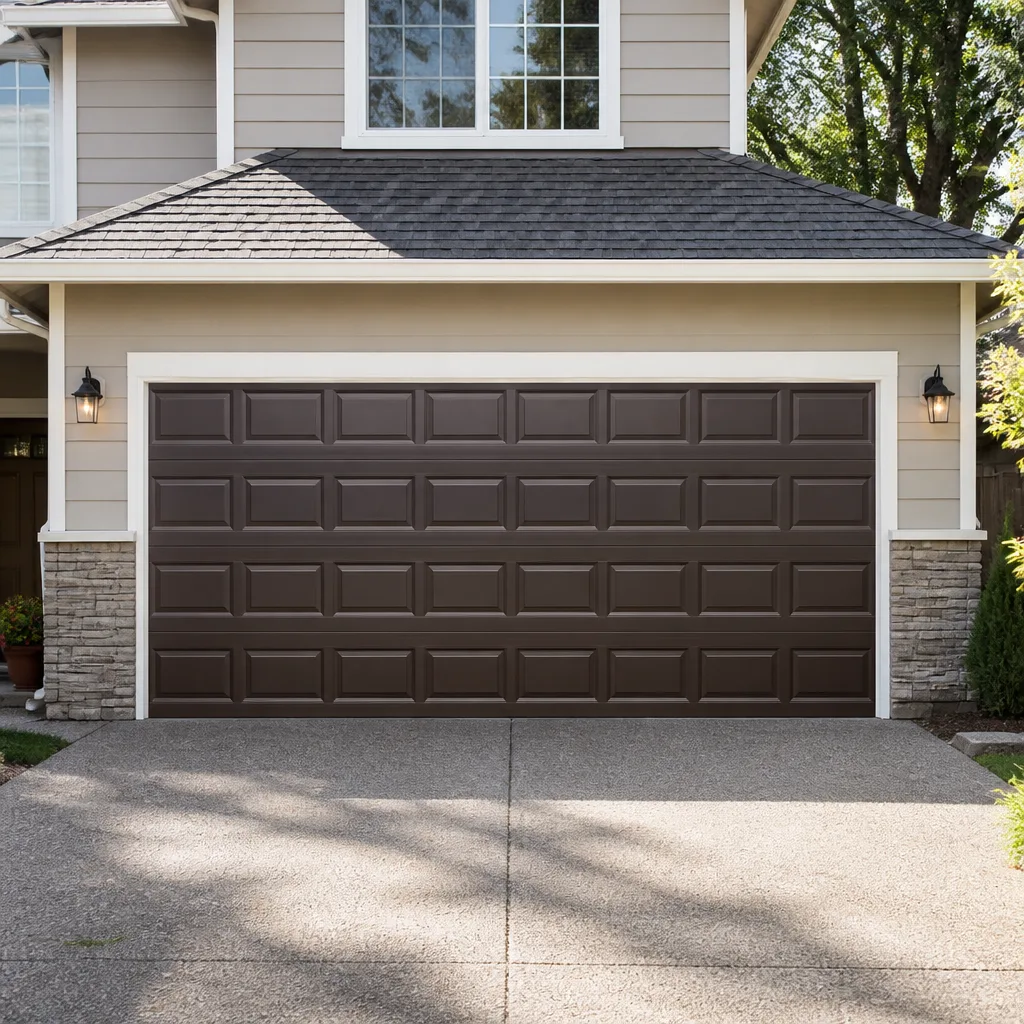 Raised-panel steel
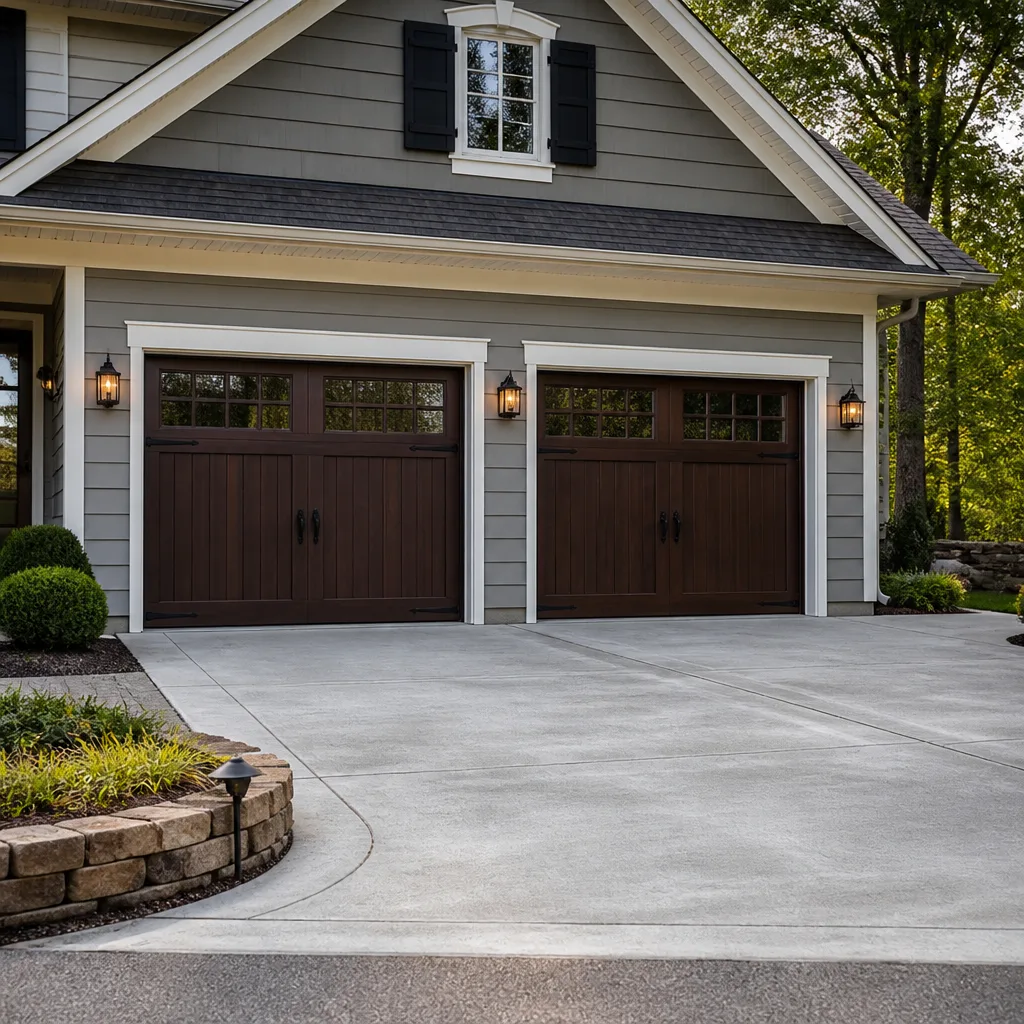 Carriage house
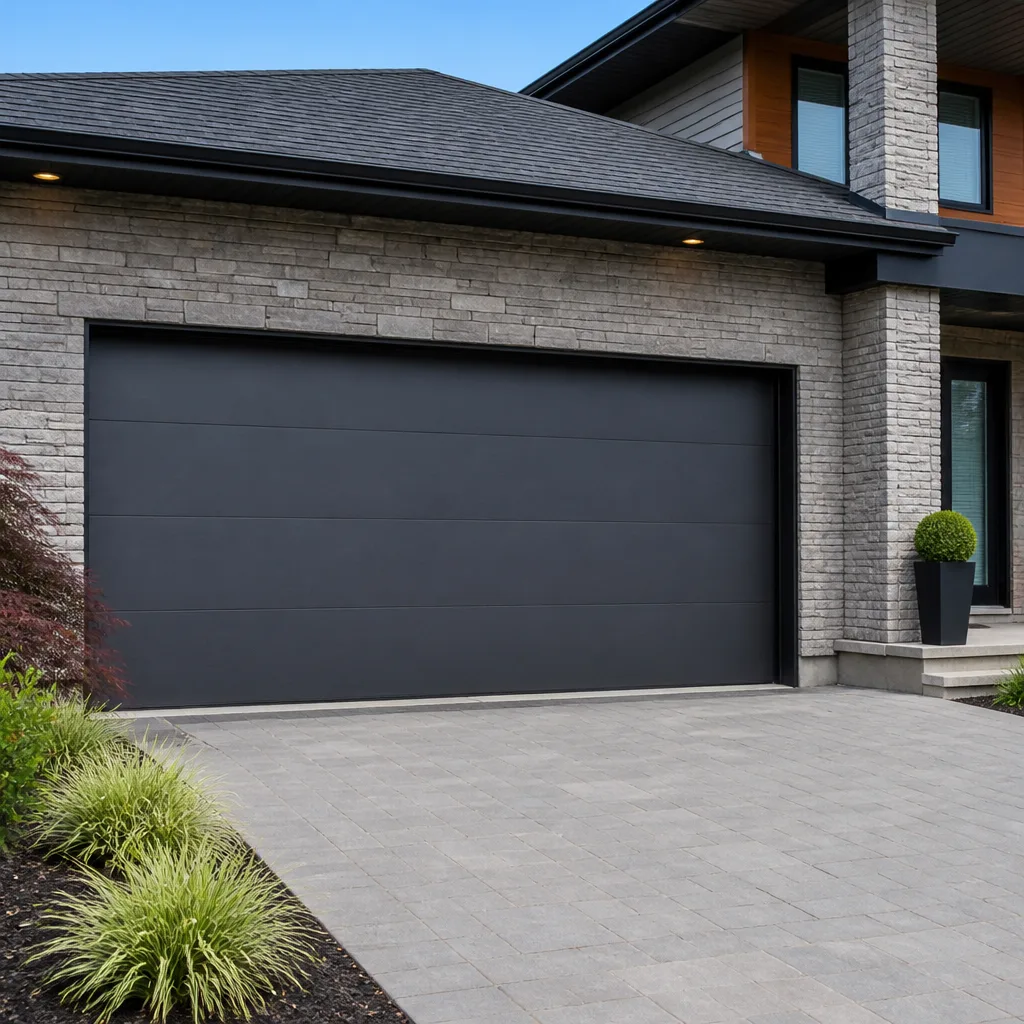 Modern flush
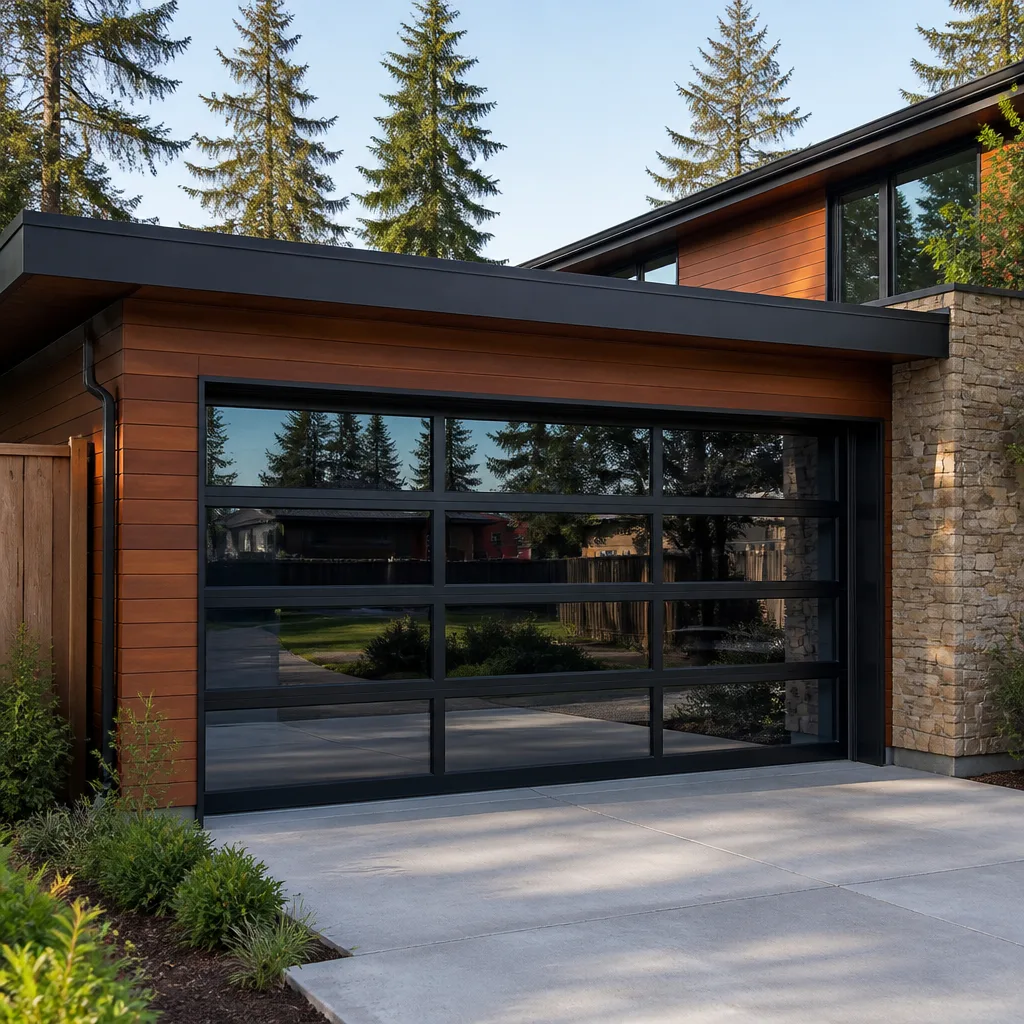 Full-view glass
 LiftMaster openers
 Chamberlain openers
Full 25-point door and opener safety check with every visit - springs, cables, rollers, tracks, and your LiftMaster or Chamberlain opener included
You get a price before we start. It does not change when the truck arrives.
Get your free estimateSeasonal Garage Door Care for Fort Lauderdale: Year-Round Homeowner’s Guide
Here’s the reality most seasonal garage door guides miss: Fort Lauderdale doesn’t have a fall winterizing season or a spring thaw checklist. We live in a subtropical climate where the calendar splits into three distinct stress periods – the dry season, the wet season, and a hurricane season that cuts straight through both. A garage door in Fort Lauderdale faces salt-laced humidity for eight months, afternoon lightning storms that scramble opener circuit boards, and a stretch from June through November where your garage door is literally the largest opening in your home’s wind envelope. This guide breaks down what to do and when to do it, based on what we see in garages across Fort Lauderdale every single week, and you can find more guides & resources on our blog.
Styles & brands we work with
Quick Answer
Seasonal garage door care in Fort Lauderdale comes down to three windows: a pre-hurricane-season prep in April and May, wet-season monitoring from June through October focused on seals and corrosion, and dry-season maintenance from November through March when spring replacement and opener upgrades are easiest. Year-round, homes within one mile of the Intracoastal or ocean need additional salt air defense on hardware and tracks.
Table of Contents
- The Pre-Hurricane Season Window: April to May
- Wind Bracing, Design Pressure, and Insurance Credits
- Wet Season Wear: June Through October
- Lightning Storms and Opener Vulnerability
- The Dry Season: November Through March
- Salt Air Defense for Intracoastal and Beach Homes
- The Right Lubrication Routine for This Climate
- Common Mistakes to Avoid
- When to Call a Professional
- Frequently Asked Questions
- The Bottom Line
The Pre-Hurricane Season Window: April to May
The six weeks before June 1st is the most important maintenance window in Fort Lauderdale, and barely anyone uses it. Every year we watch the same pattern: a named storm forms in the Atlantic, the cone includes South Florida, and suddenly every garage door company in Broward County is booked solid for two weeks. If your door has a problem, you don’t want to discover it when a storm is 72 hours out and you can’t get a technician.
Here’s what needs to happen in April and May:
- Test the manual release function. Pull the red emergency release cord and lift the door by hand. It should raise smoothly to about waist height and stay there without drifting. If it slams down or won’t hold, the springs are failing or improperly balanced. Do this before a storm makes manual operation your only option.
- Check every hinge, roller, and bracket bolt. Wind load puts enormous stress on attachment points. Loose hardware that would never be an issue in calm weather becomes a failure point when a 100 mph gust hits the door face.
- Inspect weatherstripping along the bottom and sides. Storm-driven rain runs horizontally in South Florida, not vertically. Gaps in side seals let water blast into your garage during even a moderate tropical storm.
- Confirm the opener’s battery backup works. If you have a LiftMaster or Chamberlain opener with a battery backup unit, unplug it and test the door. Replace batteries that won’t hold a charge. Power outages in Fort Lauderdale during storms are measured in days, not hours.
- Verify wind bracing is installed and functional. More detail on this below, but the short version: if your door is rated for wind load, the bracing posts and tracks do the heavy lifting. If they’re bent, rusted, or missing, the rating means nothing.
We get calls every September from homeowners who skipped this window. The conversation is always harder in September than it would have been in May.
Wind Bracing, Design Pressure, and Insurance Credits
Here’s a topic most garage door care guides skip entirely, and it’s more valuable to a Fort Lauderdale homeowner than any lubrication tip—though our Complete Garage Door Repair Guide for Fort Lauderdale Homeowners covers both. Your garage door is the largest single opening in the front wall of your home. When it fails in a hurricane, the wind pressure inside the garage can lift the roof and blow out walls. Building codes in Broward County recognize this, which is why garage doors installed after 2002 typically require a design pressure rating and wind-load certification.
Start by checking whether your door qualifies as wind-rated. Look for a metal label or sticker on the door panel, usually near the bottom corner. It will list a design pressure rating in pounds per square foot (PSF), with common ratings in Fort Lauderdale ranging from 50 to 80 PSF depending on location and home design. If you can’t find the label, a garage door installation specialist in Fort Lauderdale can identify the door model and verify its rating.
But here’s the part most homeowners miss: wind-rated doors in South Florida almost always require the installation of active or passive wind bracing systems. These are horizontal steel posts or struts that run across the inside of the door, transferring wind load from the door panels to the tracks and into the wall structure. A wind-rated door without functioning bracing is no better than an unrated door. We’ve seen homes in Fort Lauderdale where the bracing posts had been removed during a repair years ago and never reinstalled.
Insurance angle: Florida insurance companies offer wind mitigation credits for homes that can document wind-rated openings, including the garage door. The credit comes from a wind mitigation inspection form (Form 1802), and the garage door section can make a real difference in annual premium savings. If your door has a design pressure rating and proper bracing, make sure the inspection documents it. If your door is pre-2002 and unrated, replacing it with a wind-rated Amarr or Clopay model can unlock those credits, often offsetting part of the installation cost through premium reductions over time. Garage door repair in Fort Lauderdale should always include verification that wind bracing is present and functional after any significant hardware work.
What to check on the bracing itself: posts should be straight with no visible bends, attachment brackets should be tight, and the posts should run continuously, not cut or notched. Corrosion at bracket points is the most common failure we see, especially in homes east of Federal Highway where salt air accelerates metal fatigue.
Wet Season Wear: June Through October
The wet season in Fort Lauderdale isn’t just rainy. It’s hot, still, and humid, with afternoon thunderstorms that roll in fast and dump an inch of rain in 30 minutes. This environment does two things to a garage door: it attacks the seals, and it accelerates corrosion on every exposed metal component.
The bottom seal, or astragal, is the rubber strip along the bottom edge of the door. It takes direct abuse in the wet season. Daily downpours, flooding at the garage apron, and constant UV exposure (which degrades rubber even on cloudy days) all work against it. A worn bottom seal lets water, leaves, and even small critters into the garage. But the bigger issue is that water pooling against the bottom panel accelerates rust on the panel edge and the bottom bracket hardware.
The side and top seals matter almost as much. In Fort Lauderdale’s wet season, wind-driven rain regularly hits doors from angles that bottom seals never see. Side vinyl trim and top draft stops crack and shrink over time, especially on western-facing exposures that get the brunt of afternoon storms. Run your hand along the inside edge of the door during the next heavy rain. If you feel air movement or moisture, the seals need replacing.
Corrosion is the other wet-season constant. Exposed springs, track brackets, hinge pins, and roller stems all develop surface rust faster here than in almost any other U.S. climate. Salt air makes it worse, which we’ll cover below. The practical takeaway is this: wet season is a monitoring season, not a heavy repair season. Inspect monthly. Repair small issues before they become big ones. Replacing a rusty bracket is a quick job. Replacing a track section that rusted through is not.
We also recommend checking your garage floor for standing water during heavy rains. If water is entering under the door, the issue is usually the bottom seal or a concrete apron that has settled over time. Both are fixable, and both should be addressed before dry season gives them months to worsen.
Lightning Storms and Opener Vulnerability
Fort Lauderdale gets more lightning strikes per square mile than almost anywhere in the United States, and your garage door opener is one of the most exposed electrical devices in the home. Here’s the set-up that causes most failures: the opener is plugged into a garage branch circuit, the circuit is connected to the main panel, and the panel is fed by an overhead service drop that runs through the storm. A nearby strike doesn’t have to hit your house directly to send a surge through the system.
What fails first is almost always the logic board inside the opener. Chamberlain and Genie openers made in the last decade have more sophisticated electronics than their 1990s counterparts, which makes them more capable and more fragile. A surge that would barely register on a ceiling fan can fry a logic board’s resistors. If you need garage door opener repair in Fort Lauderdale after a summer storm, the diagnosis is usually “logic board took a surge,” and the fix is board replacement.
What you can do:
- Install a plug-in surge protector on the opener’s outlet. This is the single highest-value surge defense for garage door openers, and it costs less than a pizza.
- Check the opener’s ground path. Older garages in Fort Lauderdale sometimes have ungrounded outlets or loose ground connections. An electrician can confirm this in minutes.
- Consider a whole-home surge protector at the panel. This adds a second layer beyond the plug-in unit and protects every circuit in the home, including the garage branch.
- Test the opener monthly after storms. If the lights flicker, the remote signal range drops, or the motor hums without moving the door, the board may have taken partial damage.
We get more opener repair calls in August and September than the rest of the year combined in Fort Lauderdale. The pattern is predictable enough that we plan technician coverage around it.
The Dry Season: November Through March
From a maintenance standpoint, the dry season in Fort Lauderdale is the reward for surviving the wet season, as detailed in The Complete Guide to Garage Door in Fort Lauderdale. Temperatures moderate slightly, humidity drops from brutal to merely noticeable, and afternoon rain becomes rare. It’s also the window when we recommend the heavy work: spring replacement, panel refinishing, and opener upgrades. Here’s why the timing matters.
Torsion springs have a service life measured in cycles, not years. A ten-year-old door that cycles twice a day has roughly 7,300 cycles on the springs. Standard springs are rated for 10,000. If your door is in that window, replacing springs proactively in January means you avoid the 7 a.m. failure on a Tuesday in April when you’re late for work and the door won’t open. In their experience, Gateway Garage Door Repair technicians report that dry-season replacements are faster and cleaner because hardware isn’t wet, corroded, or covered in the salt film that builds up over the wet season.
Panel painting and refinishing is also a dry-season job. The lower humidity means paint and sealants cure properly and adhesion lasts longer. If you’re repainting a Clopay or Amarr steel door, the dry season gives you the best conditions for a finish that survives multiple wet seasons, which is why Choosing the Right Garage Door Brand: A Buyer’s Guide for Fort Lauderdale emphasizes timing your installation wisely. Avoid painting in May or June when rain can hit before the paint fully cures.
Opener upgrades follow the same logic. Swapping in a modern LiftMaster or Chamberlain myQ opener means running new wiring, mounting new equipment, and programming the unit. None of that benefits from a 90-degree garage with 80 percent humidity. The dry season offers comfortable working conditions and plenty of lead time before next hurricane season.
One more dry-season advantage: scheduling flexibility. Most Fort Lauderdale homeowners aren’t thinking about their garage doors in February, which means you have your pick of appointment times. In May, demand spikes and wait times increase overnight. If your door is nearing the end of its service life, or your opener is a legacy Craftsman or Wayne Dalton unit that’s 20 years old, dry season is the time to address it, not storm season.
Salt Air Defense for Intracoastal and Beach Homes
Fort Lauderdale stretches from the beach west to the Everglades, and the salt air gradient is real. Homes within one mile of the Intracoastal Waterway or the Atlantic Ocean experience significantly faster corrosion on all exposed metal. Garage doors are uniquely vulnerable because they combine steel panels, steel hardware, and steel tracks, all of which oxidize faster in salt-laden air. Here’s the science in plain terms: salt particles suspended in humid air settle on metal surfaces, and the moisture in the air activates them as an electrolyte, accelerating rust.
What this means for your garage door:
- Rust appears faster and spreads quicker. Surface rust on hinges and brackets that might take five years to develop inland can appear in two years east of US-1.
- Roller stems and bearings are early failure points. These are precision parts with tight tolerances. Even light surface rust creates friction, which accelerates wear across the entire door system.
- Track fasteners loosen sooner. The combination of salt corrosion and vibration from daily cycling works bolts loose over time. Salt-accelerated corrosion eats the metal around the fastener head, reducing holding power.
The defense routine for salt-exposed homes in Fort Lauderdale looks like this:
- Rinse quarterly. Use a garden hose to wash the door face, tracks, and hardware. No pressure washer, just a gentle rinse to move salt accumulation off the surfaces. Wipe down with a clean cloth afterward, focusing on hinge points and roller stems.
- Apply a corrosion inhibitor quarterly. After the rinse, apply a light coat of a corrosion-preventive spray to all hardware, including hinges, brackets, track bolts, and spring coils. Avoid getting product on the door face, as it can streak the finish.
- Lubricate monthly during the wet season, bimonthly in the dry season. The lubrication routine (below) is more than just noise control. For salt-exposed homes, the lubricant layer doubles as a moisture barrier.
- Inspect tracks and hardware for rust monthly during the wet season. Catch surface rust early and address it with a wire brush and rust-inhibiting primer. Once rust penetrates through the metal, replacement is the only option.
The houses that do this consistently have doors that last 15 to 20 years in Fort Lauderdale’s coastal environment. The houses that skip it are replacing panels and hardware at the 8 to 10 year mark.
The Right Lubrication Routine for This Climate
Lubricating a garage door sounds simple, and the basic idea is. But Florida’s climate makes the details matter more than they do elsewhere. Use the wrong product, and you’ll actually make things worse. Use the right product at the wrong intervals, and you’ll still see premature wear.
What to use: A white lithium grease spray for metal-to-metal contact points (hinges, spring coils, roller stems), and a silicone-based spray for nylon parts and weatherstripping. Avoid WD-40 and similar penetrating oils for lubrication; they’re designed to break rust, not provide long-term lubrication, and they evaporate too quickly in heat. They also attract dust, which turns into grit, which accelerates wear.
What to lubricate:
- Torsion springs. These coils flex thousands of times per year. Without lubrication, coil friction causes premature spring wear and that telltale squeak every time the door moves.
- Hinge points. Every hinge is a metal-on-metal joint that needs periodic lubrication to prevent binding.
- Roller stems. The stems, not the wheels themselves. Nylon rollers should never be lubricated at the wheel; the stem is what rotates against the hinge barrel.
- Track brackets and lock hardware. Anything that moves or holds a moving part.
Fort Lauderdale-specific frequency: The heat and humidity here break down lubricant films faster than in drier or cooler climates. We recommend lubricating every three months year-round as a baseline, and monthly during the wet season for coastal homes. In our experience, doors in Fort Lauderdale that get quarterly lubrication consistently last years longer than doors that get attention only when they start making noise.
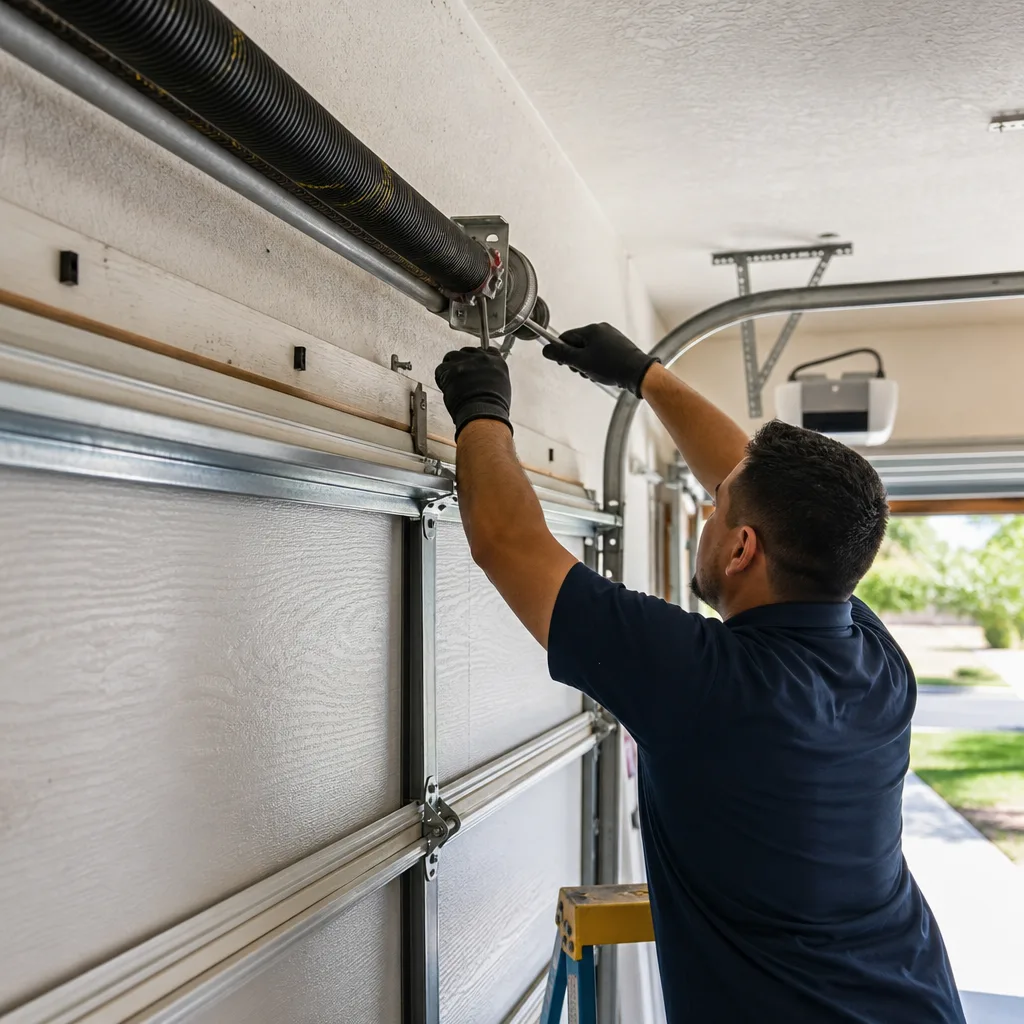
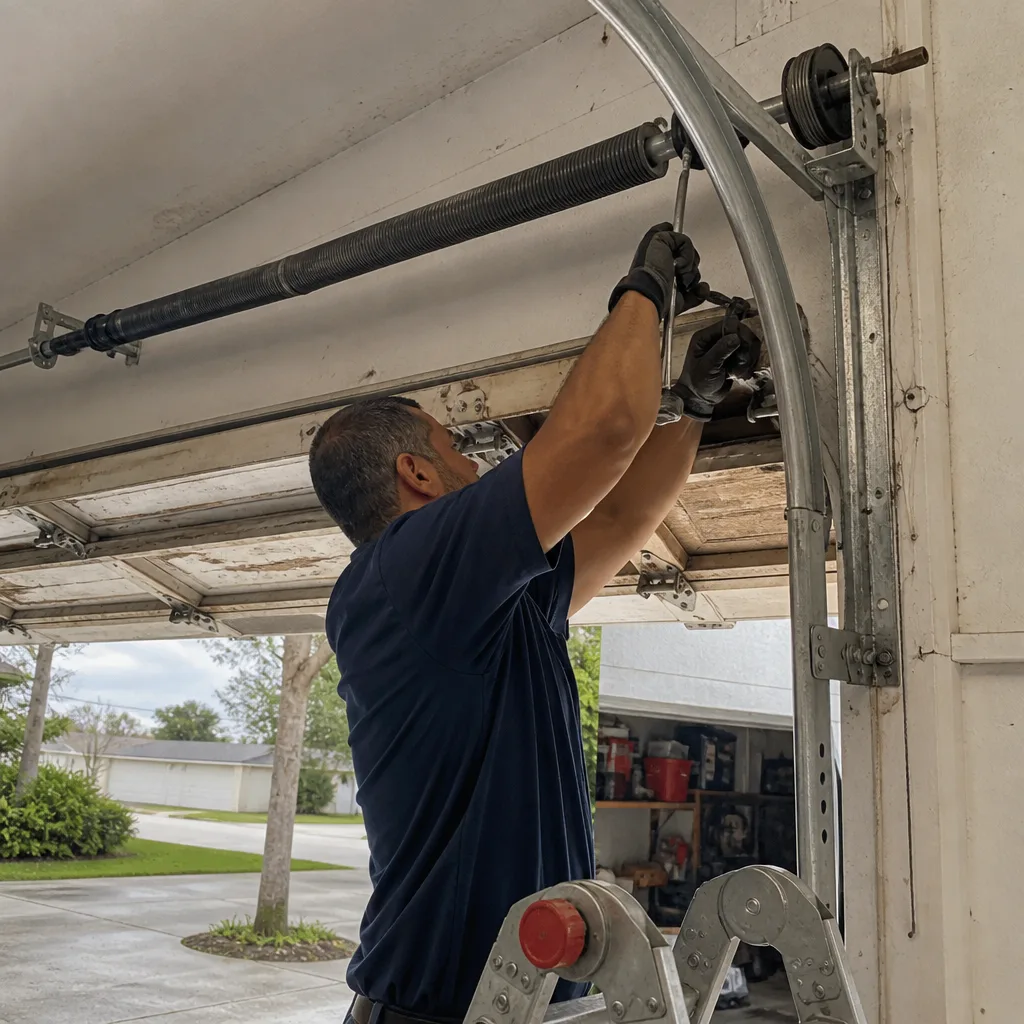
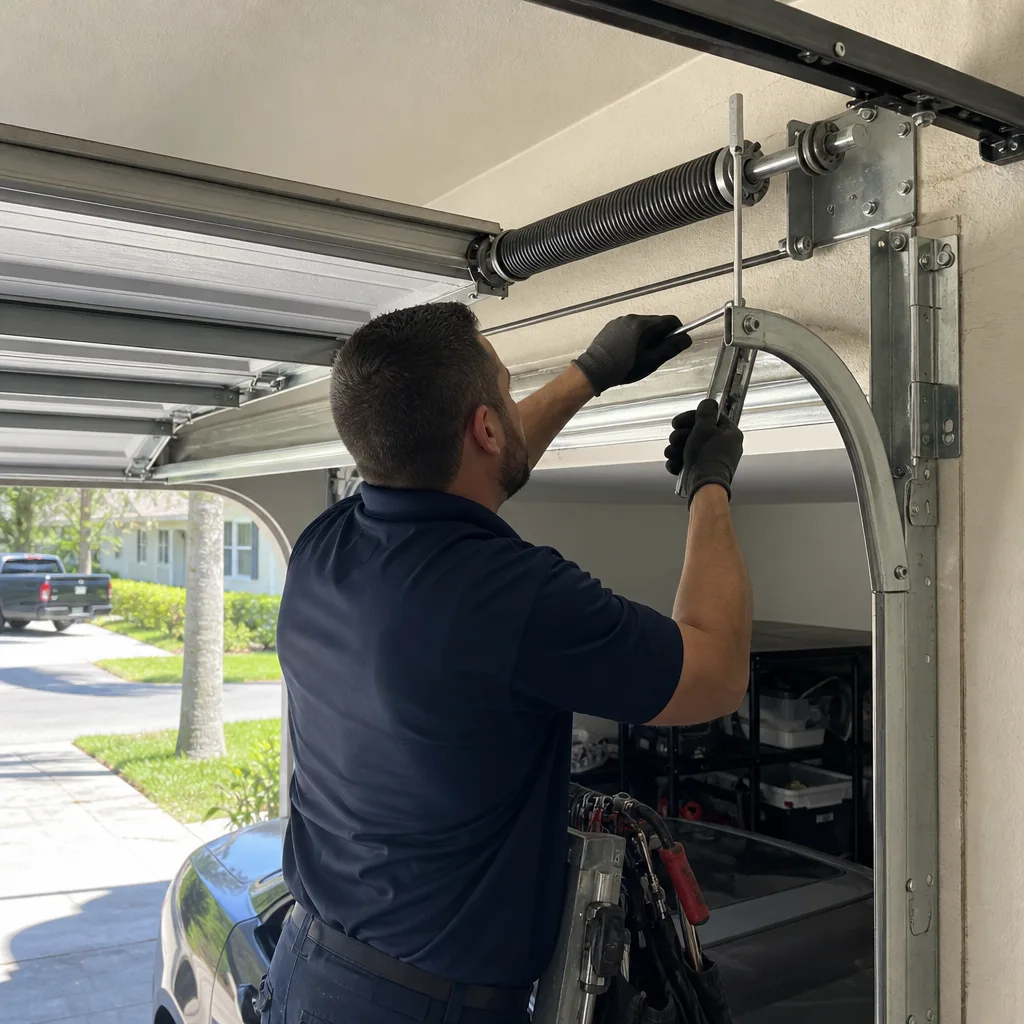
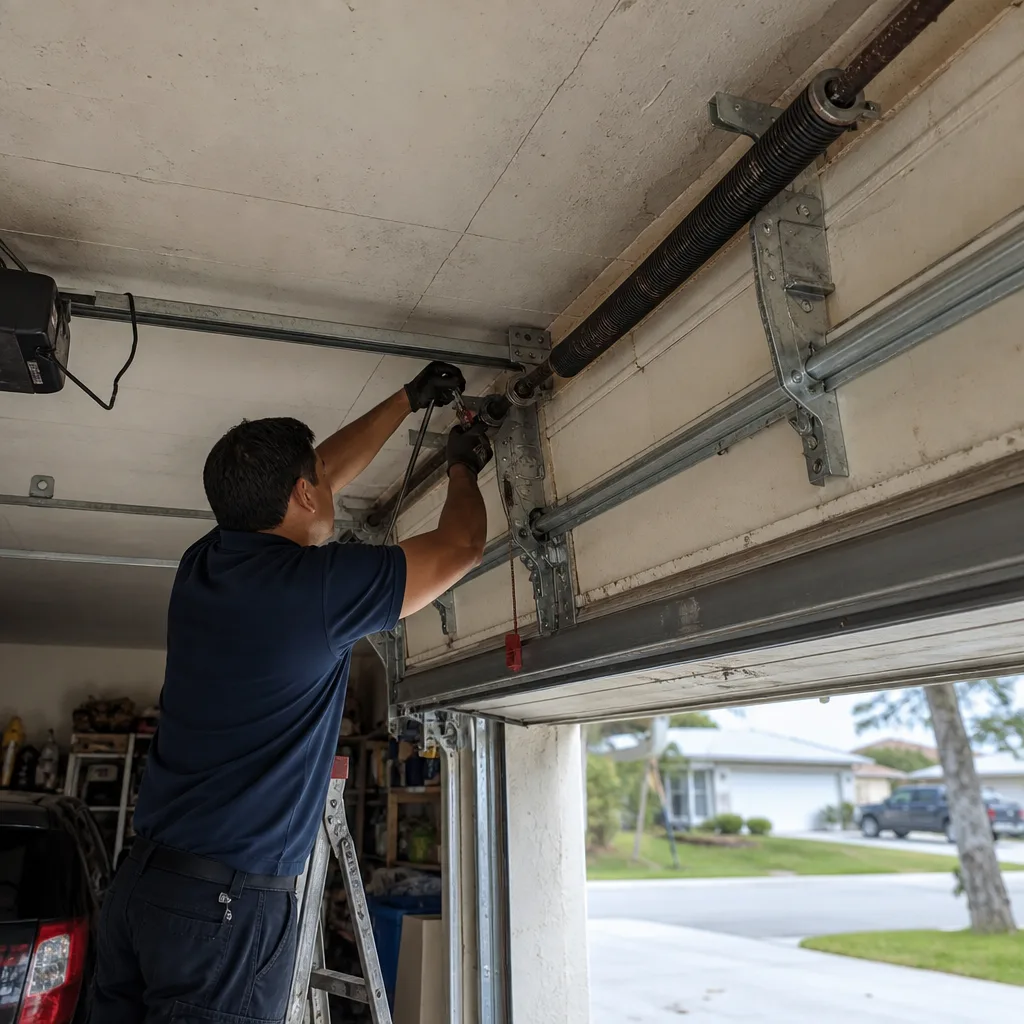
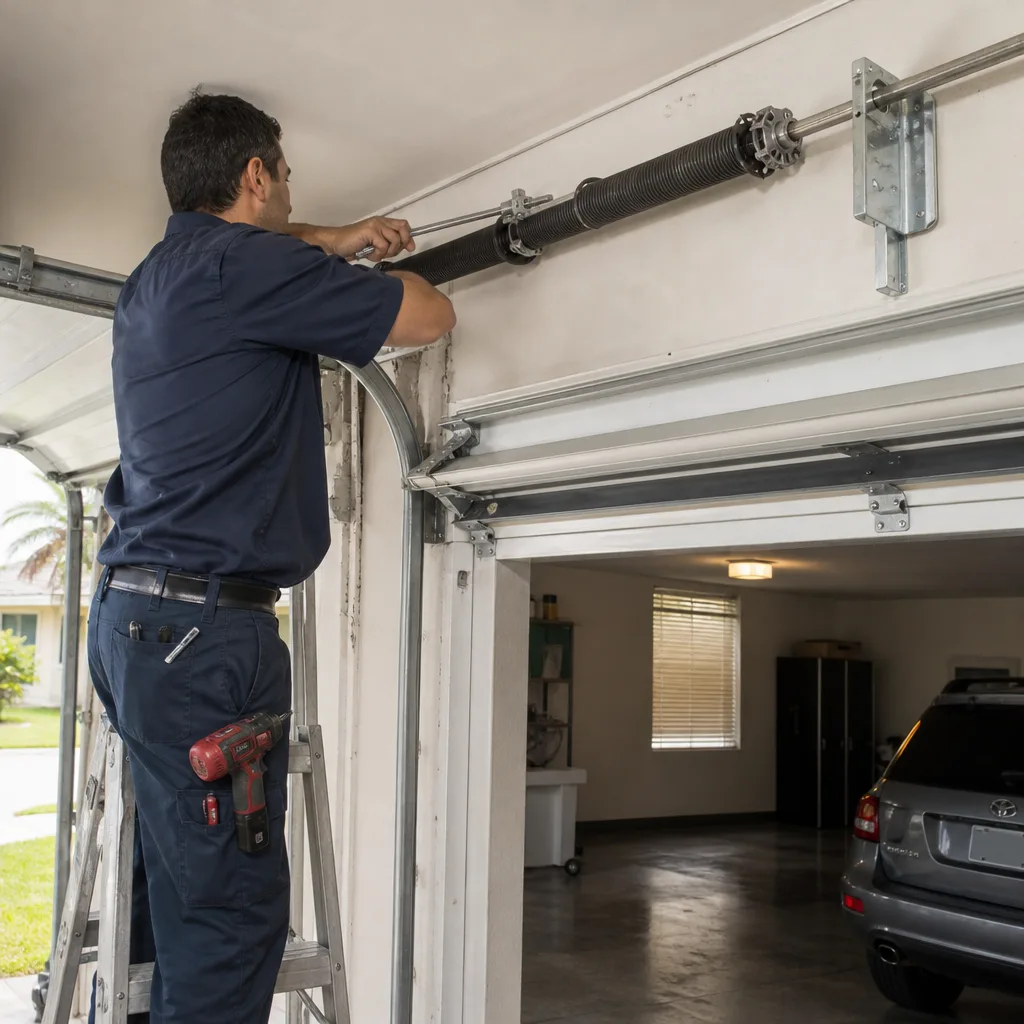
One caution on DIY lubrication: torsion springs under tension are dangerous components. Lubricating them is safe because you’re not touching the spring or its mounting hardware. But if your lubrication routine reveals a spring that looks rusted, corroded, or stretched on one side, do not attempt any repair. That’s a professional replacement job, full stop. Springs under tension can cause serious injury or death if mishandled, which is why Gateway Garage Door Repair home technicians handle spring work with specialized tools and training.
Common Mistakes to Avoid
- Skipping the April – May inspection window. Waiting until a storm is named means you’re competing with thousands of other homeowners for a limited number of technician appointments in Fort Lauderdale. The work that should have been done in May becomes an emergency in September.
- Using WD-40 as a garage door lubricant. It’s a penetrating oil designed to free stuck parts, not a lubricant. It evaporates fast in Florida heat, attracts dust, and leaves the joint drier than before. Use white lithium grease or silicone spray instead.
- Ignoring the manual release function until you need it. The emergency release is the backup plan when the opener fails or power is out. If you’ve never tested it, you don’t know if it works. Test it monthly during hurricane season.
- Repainting a panel without addressing rust underneath. If you cover surface rust with paint, it continues to corrode under the finish, and the panel fails from the inside out. Fort Lauderdale’s humidity guarantees the rust keeps growing. Strip it, treat it, then paint.
- Replacing a spring without checking the other spring and the cables. Torsion springs wear together. If one failed, the other is usually close behind. Replacing a single spring means a second failure within months, often at a worse time. Replace both, and inspect the cables while you’re in there.
- Overlooking wind bracing after repairs. Too many door repairs in Fort Lauderdale leave wind bracing disconnected or removed without reinstalling it. After any significant door or track work, verify the bracing posts are back in place and tight.
- Pressure washing a garage door at close range. High-pressure water forces its way into seams, around panels, and behind weatherstripping. It can also strip paint and damage sealants. A garden hose at moderate pressure does everything a garage door needs for cleaning.
When to Call a Professional
Some garage door work is genuinely DIY-friendly: testing seals, checking visible hardware, rinsing salt accumulation, lubricating hinges. But the moment the job involves torsion springs, cables under tension, track realignment, or opener logic board work, call a specialist. These components store enormous energy and operate under load. A failed DIY spring replacement is one of the most common calls we respond to in Fort Lauderdale, and it’s always more expensive than the original repair would have been. Garage door repair specialists in Fort Lauderdale have the training and tools to handle spring replacement, cable work, and opener diagnostics safely. Gateway Garage Door Repair offers free estimates in Fort Lauderdale. Call (844) 713-7316 to schedule an inspection. One call covers the door and the opener, and we’ll diagnose it right the first visit.
Frequently Asked Questions
In Fort Lauderdale, you’ll typically pay between $180 and $380 for a pair of torsion springs replaced by a professional, depending on the spring size, cycle rating, and door weight. Coastal homes often upgrade to higher-cycle springs (20,000 to 30,000 cycles) for $50 to $100 more per pair, which makes sense given the corrosion environment. Call (844) 713-7316 for an exact quote, always provided before any work starts.
You can, but you shouldn’t. Disconnect the opener and lock the door manually before leaving, confirm the manual release works, and consider unplugging the opener to protect it from lightning surges while the house is empty. A surge protector adds another layer of defense if you leave the opener plugged in for security or smart-home reasons.
Yes, if it’s documented on your wind mitigation inspection form. Florida insurers offer premium credits for garage door opening protection systems, including wind-rated doors with proper bracing. The savings vary by carrier and home, but the credit can be significant over time. If your current door lacks a rating, replacement with a rated model is often partially offset by these savings.
Heat and humidity expand metal components, narrowing clearances and increasing friction at hinge points and roller stems. Add the salt air corrosion factor in coastal Fort Lauderdale, and summer is prime time for noisy doors. The fix is usually lubrication, but persistent grinding or screeching after lubrication points to worn rollers, hinge failure, or spring wear that needs professional attention.
Gateway Garage Door Repair offers same-day repair service in Fort Lauderdale for spring failures and other urgent issues. Call (844) 713-7316 as early as possible to get on the schedule. Broken springs only get more expensive when the door sits unbalanced, so the sooner we can address it, the less secondary damage the door sustains.
For homes within one mile of the ocean or Intracoastal in Fort Lauderdale, lubricate monthly during the wet season (June through October) and every two months during the dry season. Combine each lubrication with a quick visual check for rust on hinges, brackets, and spring coils. Inland homes can stretch to quarterly year-round.
The price we quote for a repair is the price you pay, unless the technician finds additional damage that requires your approval before any additional work begins. You’ll always know the total before we proceed. That’s how Gateway Garage Door Repair works in Fort Lauderdale: upfront pricing, no surprises.
The Bottom Line
Seasonal garage door care in Fort Lauderdale is about respecting the climate you actually live in, not the climate patterns of northern states with real winters. The three windows matter: April and May for hurricane prep, June through October for wet-season monitoring, November through March for repairs and upgrades in the drier months. Coastal homeowners need to layer salt air defense on top of everything. A well-maintained garage door in Fort Lauderdale lasts 15 to 20 years, while an ignored door in the same climate can need panel replacement in 8. The difference isn’t luck; it’s the calendar, the routine, and knowing when to call a specialist instead of guessing. For help with any of it, call Gateway Garage Door Repair at (844) 713-7316. Your garage door is your home’s hardest-working entry point, and it deserves a maintenance plan built for Fort Lauderdale, not for Ohio.
Written by the team at Gateway Garage Door Repair, serving Fort Lauderdale since 2014.
See the difference
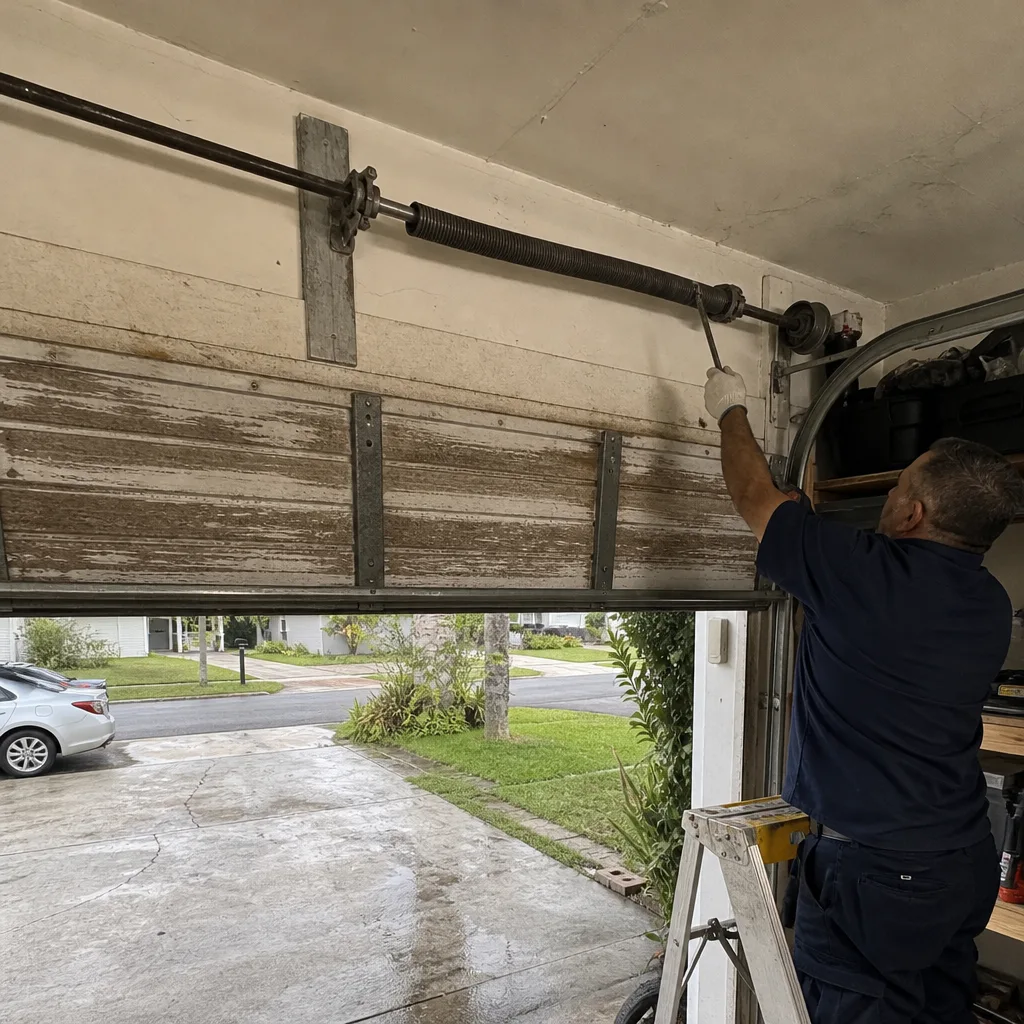 Before
 After
 Before
 After
 Before
 After